

The advantage of being bisexual is that it doubles your chances of finding a date on a Saturday night.
Woody Allen
The quote was originally uttered by Woody Allen, but was later quoted by Warren Buffett in one of his shareholder letters. Buffett was alluding to Berkshire’s long-term flexibility in investing in both publicly listed securities and private companies.
I have often kept that thought in mind. Agility and flexibility are arrows that a sharp investor should keep in their quiver, just in case a target comes along that is worth taking aim at.
As an investor, I aspire to buy and hold positions for long periods of time, to make the most of the compounding opportunity. The vast majority of my portfolio has an original initiation date of four to five years ago, with Berkshire, my largest and core holding, first initiated as far back as August 2017.
But I am also willing to take short-term positions when the opportunity offers an excellent return for the risk I am taking, even after accounting for the higher transaction costs and taxes that come with shorter holding periods.
Recently, I heard about Accenture’s precipitous drop after its latest results.
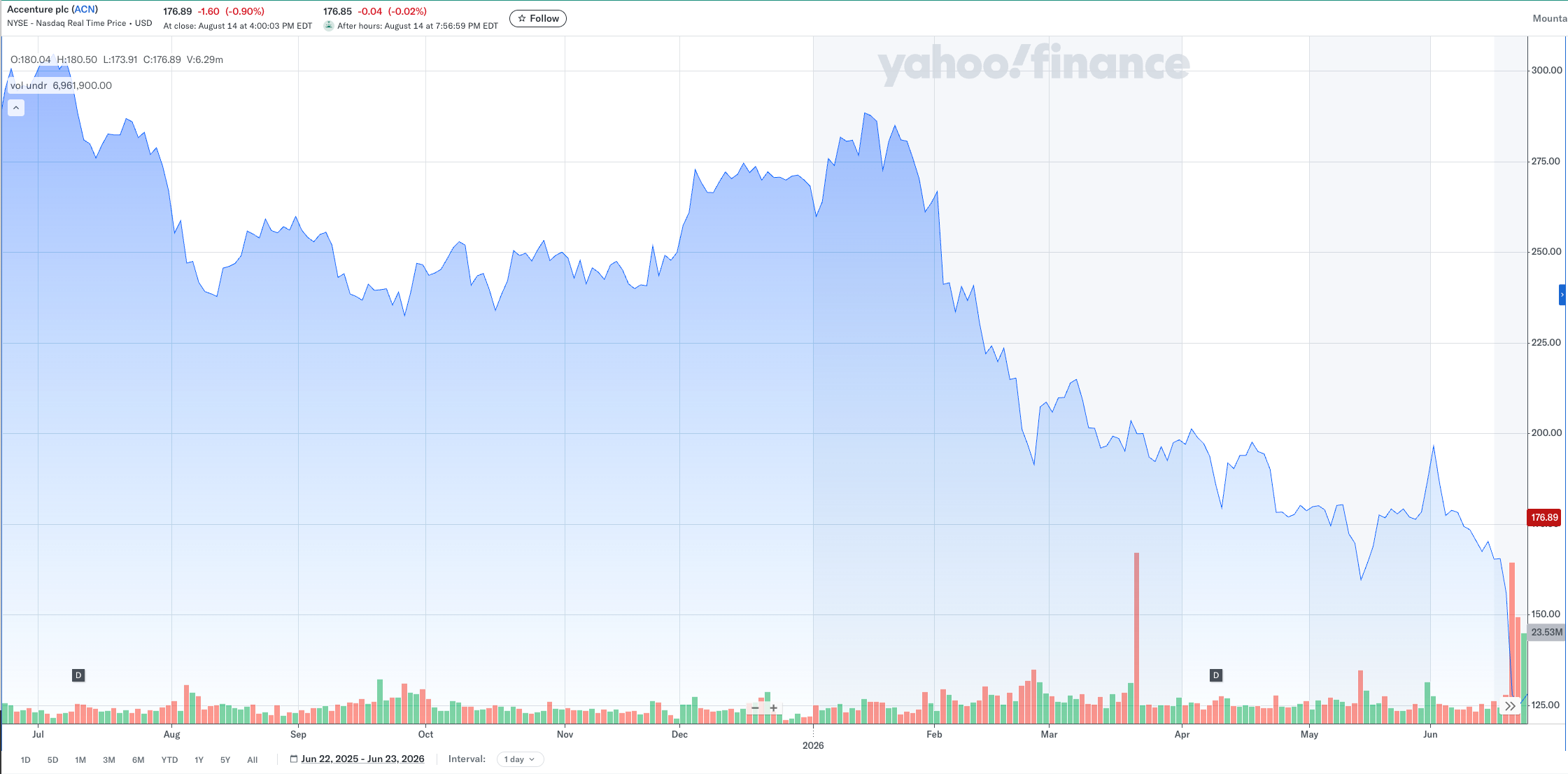
The earnings report that came out on June 18th was not flattering, even by a fairly wide margin. But the report itself didn’t seem to justify the scale of the stock’s subsequent collapse.
On June 15th, the stock traded at $165. By June 18th, it was at $128. By June 23rd, it was still at $127, having only just shown some signs of upside momentum after several days of being beaten down.
In those five days, I was spending a lot of time reading about Accenture as voraciously as I could.

Accenture is an extremely well-known company in IT and media consulting, with an employee count of some 750,000-800,000 people. It is a behemoth. Almost every large enterprise in the world is either a customer, has been one, or at least has been pitched by Accenture at some point.
I have overlapped with that world on a few occasions, and generally understand the business. Over the years, I have also developed a begrudging respect for their model.
Essentially, Accenture hires and trains IT talent and then engages them with enterprises on everything from routine maintenance, a low-margin business with cut-throat competition, all the way to high-end consulting work, where they can charge thousands of dollars an hour.
The business can be somewhat sticky. The low-margin work is almost always under multi-year contracts, so the cash flow keeps ticking over. The higher-end consulting work may not be as sticky, but is sufficiently high margin to compensate for the less predictable nature of that revenue.
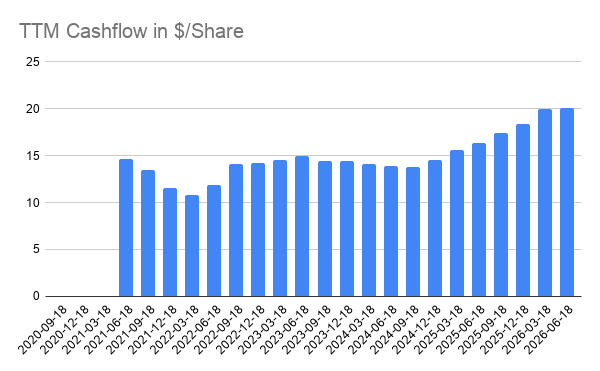
Collectively, the business has done well. Its cash flow over the past five years has amounted to roughly $77 per share. Here is the trailing twelve-month cash flow after each quarterly announcement. As you can see this is a sturdy business with an ever increasing cashflow, which just hit an all time high - independent of any other context, it is extremely flattering picture.
On the other hand, this business is possibly under intense pressure from the rise and rise of AI, which has the potential to upend the business in myriad different ways.
For one, imagine a project that previously took 100 hours to complete, with the client being charged $X per hour. If AI means the same project now takes only 50 hours, you can’t simply charge the client 2X per hour.
Do this across every single client, and suddenly a lot of your employees are free.
Unless there is enough new work to fill that capacity, revenues, and cash flow by extension, are going to take a hit.
This gets to an interesting characteristic of Accenture’s business.
The company is essentially opportunity constrained. It can employ an enormous number of people, but it ultimately needs its clients to have enough work to give those people.
If AI allows the clients to get the same amount of work done with fewer hours, the client has a choice. They can use the additional capacity to do more things, in which case Accenture gets to keep growing. Or they can simply pocket the savings, in which case Accenture loses revenue.
This is different from a bandwidth-constrained business, where the opportunity is effectively unlimited and the only constraint is the amount of talent you have available, and the price you are willing to pay for it.
Many companies move from being opportunity constrained to bandwidth constrained and vice versa.
But size creates a particular problem.
If you have 750,000 employees and suddenly 20% of them aren’t needed tomorrow, there is very little possibility of finding enough additional clients, or convincing existing clients to contract out enough additional work, to absorb that capacity in a short period of time.
And this was the crux of the market’s concern.
Everyone is trying to figure out what AI is going to do to mass employment. Accenture then dropped a bombshell of soft guidance going forward.
Combine the two, and the stock absolutely tonked.
But my thesis was slightly contrary to the market.
Here were my thoughts:
Regardless of where you thought the long-term strategy was heading, the vast majority of their book was contractually sold, and near-term revenue was therefore relatively well protected.
The job market for the talent Accenture employs had gone soft. Their input costs were therefore already lower, and were likely to remain lower, relative to each dollar of revenue coming in.
Hence, cash flow was likely to be somewhat resilient in the medium term.
The company was being prudent with that cash flow, buying back shares and paying dividends.
You see where I am going with this?
At some price, the long-term thesis simply doesn’t matter.
What matters is whether the stock has been oversold, and whether the price is attractive enough for me to underwrite the risks.
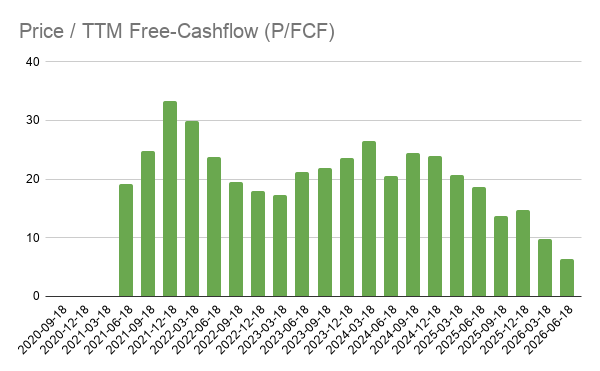
At $127, the stock was trading at 6.35x trailing twelve-month cash flow, or roughly $20 per share.
At that price, this stock looked like an absolute steal.
But I didn’t want to catch a falling knife.
Who knows what leveraged hedge fund was taking on short positions? I didn’t want to fight momentum, especially if I wanted to take a position large enough for the trade to matter.
So I waited.
On Tuesday, June 23rd, the stock stopped bleeding and finally breathed a small sigh of relief.
That’s when I went in.
I entered a 115P/135C risk-reversal trade, with expiry in March 2027. My effective breakeven price was $116, roughly 8% below where the stock was trading at the time, and still below 6x trailing cash flow.
Importantly, when I took the position, I had no particular aspirations of holding Accenture forever, or even until March 2027.
There was no great conviction behind a long-term bull thesis.
My general take was much simpler.
The stock had traded at around $165 before the collapse. I thought $165 was a reasonable price for the business. If the market eventually came around to that view again, I would be happy.
That was it.
And if you’ve been with me on this story and have already checked Accenture’s stock price, you know what happened next.
The stock went on an absolute tear.
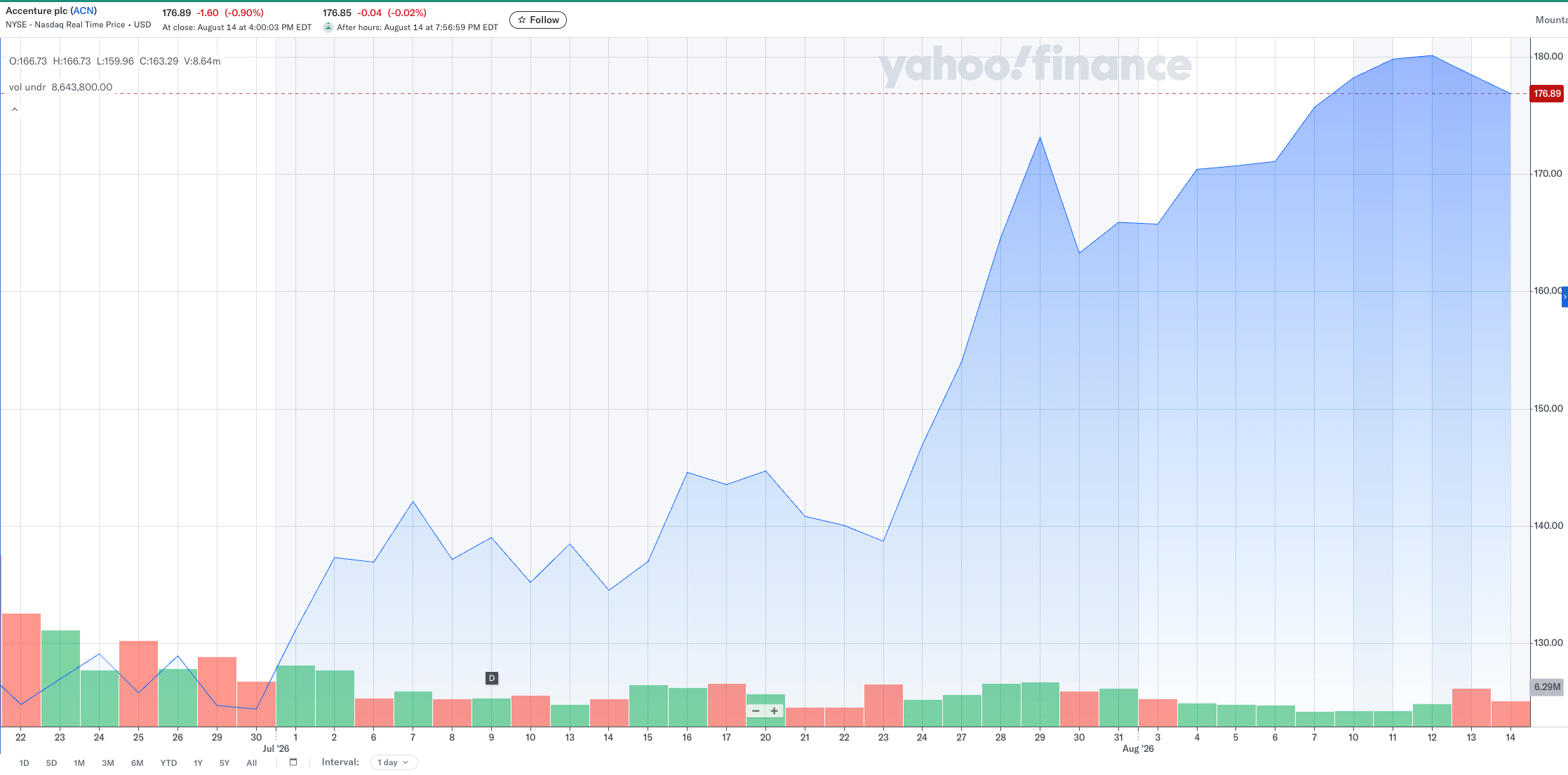
It crossed $165 in late July and hovered around that price for several days.
I took my profit, some $37 per share, and exited.
Why?
Because this was never meant to be a long-term position. I had no strong conviction in the long-term bull thesis, and without that conviction, I didn’t want to expose myself to the downside simply because the stock had gone up in the short term.
My position was also significant enough that the profits were meaningful. This short-term trade alone is expected to increase the corpus of my Coffee Can Portfolio by roughly 2%.
For six weeks of capital allocation, that’s not bad.
But it was also not worth risking those gains for a further upside that I didn’t have strong conviction in.
So, is Accenture likely to go much higher from here?
I think the chances are quite good.
Even at current prices, the stock remains significantly below where it has traditionally traded, both in absolute price and valuation terms. And whatever long-term degradation AI may eventually cause to the business, it hasn’t appeared at anything like the scale the market feared in June.
If you wish to take a punt on it, I would suggest doing your own independent research. I have already sold my position, so I have no particular skin in the game anymore.
As for this kind of short-term trade, I don’t expect to partake in too many of them.
I am not a full-time investor sitting in front of a Bloomberg terminal, waiting to identify every temporary mispricing in the market. And, in any case, I prefer having enough conviction to buy something and hold it for a very long period of time.
That’s the kind of investing I enjoy. Find a good business, buy it at a sensible price, and let time and compounding do the heavy lifting.
But flexibility has value too. Sometimes the market presents you with a gross mispricing that doesn’t require a lifetime of commitment. It just requires you to recognise the opportunity, size it appropriately, and be willing to walk away when the opportunity has run its course.
Most of the time, I want my capital to find a long-term partner.
But every now and then, a fling can be just as rewarding.
Happy Investing!
Disclaimer: I may hold positions in the tickers mentioned in this post. I am not your financial advisor and bear no fiduciary responsibility for your actions. This post is only for educational and entertainment purposes. Do your own due diligence before investing in any securities.